
Why should you care about plant collection in Belize?
Have you ever stopped to think about how many plants you use on a daily basis? The role plants play in providing the clothes on your back, the food you eat, your medicines, your furniture, your house? How many of these plants have always been here? Where did the rest come from? And who decided which ones were worth knowing, naming, and growing?
If any of these questions piqued your interest, you are thinking like a historian and/or botanist!
The truth is that plants and our knowledge of them have always been salient to human lifeways. Yet, the knowledge we (as a global collective) have of plants today has grown exponentially within the last 500 years or so. Prior to the physical and ideological connections made between the Old World and the New World, most plant knowledge and use were relatively utilitarian and localized.
So, how did it come to be that foods like mangoes, which are native to Southeast Asia, are central to Belizean diets for 4-5 months of the year? And how are avocados, which are native to Central America, now pervasive across the globe, even when there is snow covering half of it?
The answer lies in plant collection and observation.
In the Pre-Modern Old World, there were naturalists who observed their world and recorded those observations in extensive notes that were later compiled into texts. For plants, these texts are typically known as Herbals. As knowledge systems became more standardized, Linnaean taxonomy and Baconian science established more rigorous protocols for what those observations looked like and what physical data they included. For plants, this more modern approach included beautifully illustrated prints of the various parts of the plant as standard practice (prior to the widespread use of photography, of course; Taggart & Team 2024).
Eventually, botanical methods standardized the collection of a piece of each plant that was then mounted on special paper and dried to preserve it for future reference (which was, in theory, easier than creating an elaborate print of the plant). Each of these reference plants or specimens was labelled with its location, date, collector’s name, and other important context information. These dried plant specimens are invaluable snapshots of past ecologies and plant knowledge and typically housed in climate-controlled Herbaria where they continue to be essential in identifying, classifying, discovering, and analyzing plants for any number of reasons.
For Belize (British Honduras), the history of plant collection is largely one of colonial motivations as it is in most of the New World: European explorers searched for useful plants and indigenous knowledge of them to create profitable economic networks from (Antonelli 2020; Park 2023).
While the majority of plants collected within Belize were likely removed and are housed elsewhere, there is a fairly large collection of plant specimens still housed at the National Herbarium of Belize (BRH) in Belmopan, Cayo District. (Yes, Belize has its own Herbarium!) It is worth a look at what significance this collection holds for Belize, our natural resources, and cultural histories.
A review of BRH’s collections in the mid-1990s (Vargas 1997) revealed some important insights about the ecological significance of the specimens housed there. Namely, that it holds at least 84 Type Specimens and specimens of at least 25 different Threatened Species. Type Specimens are globally significant because they are the specific plant used by an author to classify a new Species, Genus, or Family (Ashworth n.d.). Because of this, they are not reproducible, meaning that if they are lost or damaged, we have no way to refer back to what the author described when naming the plant or taxon. The specimens of Threatened Species are also of global significance in that they hold data about plants that are vulnerable to becoming Endangered or Extinct in the near future (UN-REDD Programme n.d.). This means that they are essential for scientific research in combating biodiversity loss and sustainability issues such as land degradation and deforestation.
To highlight its historical significance, BRH’s collection holds insights into understanding the history of politics, knowledge production, and political ecology here in Belize. For example, the earliest known collection held in the National Herbarium of Belize was made by the first official Chief Forest Officer (then known as Conservator of Forests) for British Honduras in 1921: Cornelius Hummel. Hummel was from Germany originally, but became a naturalized British citizen in 1914 and was later assigned to initiate forestry research in British Honduras as part of efforts to establish a unified British “Empire forestry” (Smith 2021:584).
After his initial report in 1921 (which was later republished more widely in 1925; Hummel 1925), which focused on pine forests and fire (mis)management in the colony due to British Crown interests in growing a profitable pine industry, he was assigned to head a newly established Forest Department. His 1921 specimens that are still housed here in BRH include at least three well-known, hardwood species: Leptolobium (previously Sweetia or Acosmium) panamense (Carboncillo), Bucida buceras (Bullet Tree), and Manilkara zapota (previously Achras zapota; Chicle or Chico Sapote). This highlights how his research in Belize showcased more than just pine as a potentially profitable industry for the Crown.
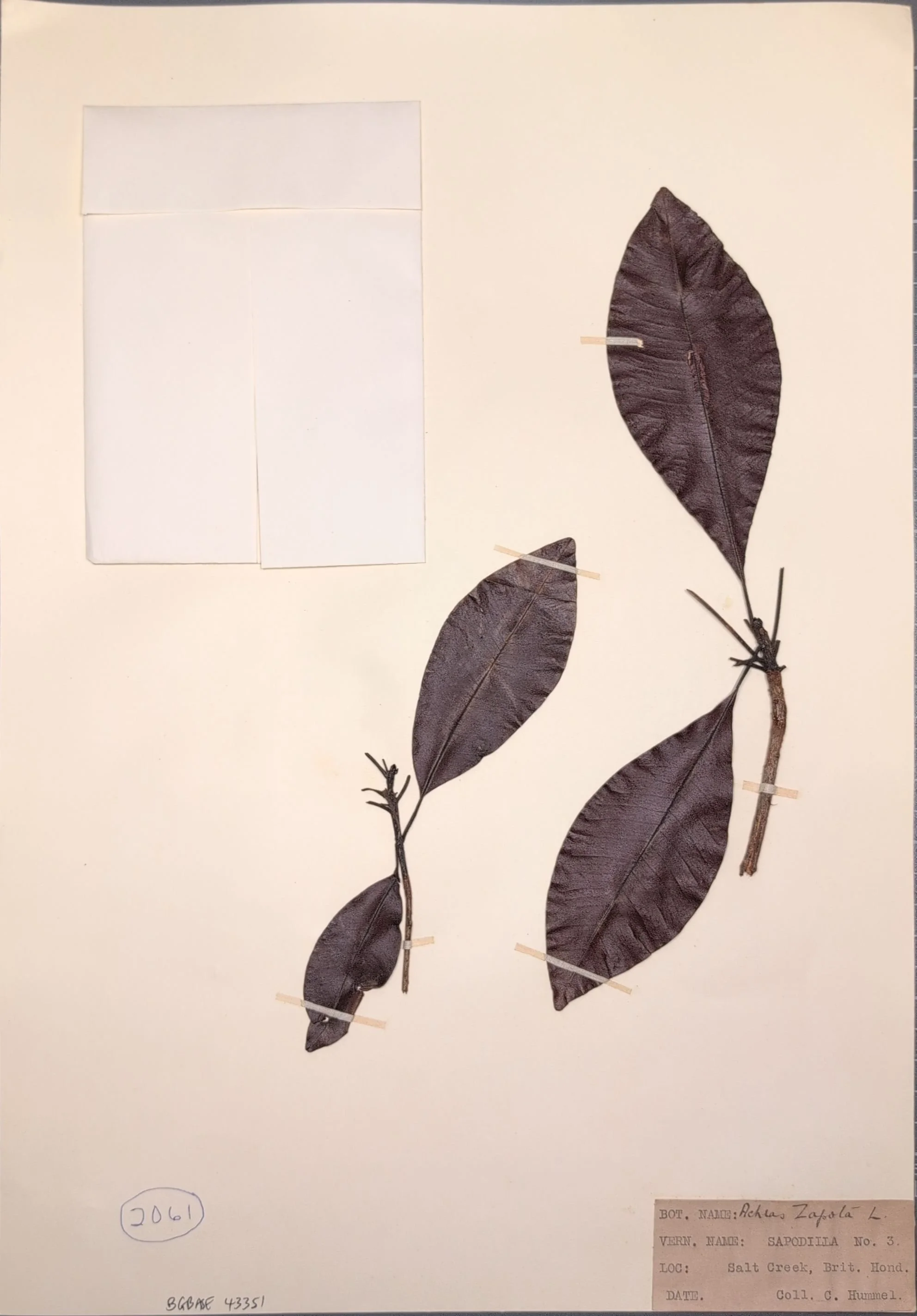
Herbarium specimen of Manilkara (Achras) zapota collected and pressed by Belize’s first CFO, Mr. Cornelius Hummel, housed in BRH, Belmopan, Cayo, Belize; courtesy of BRH
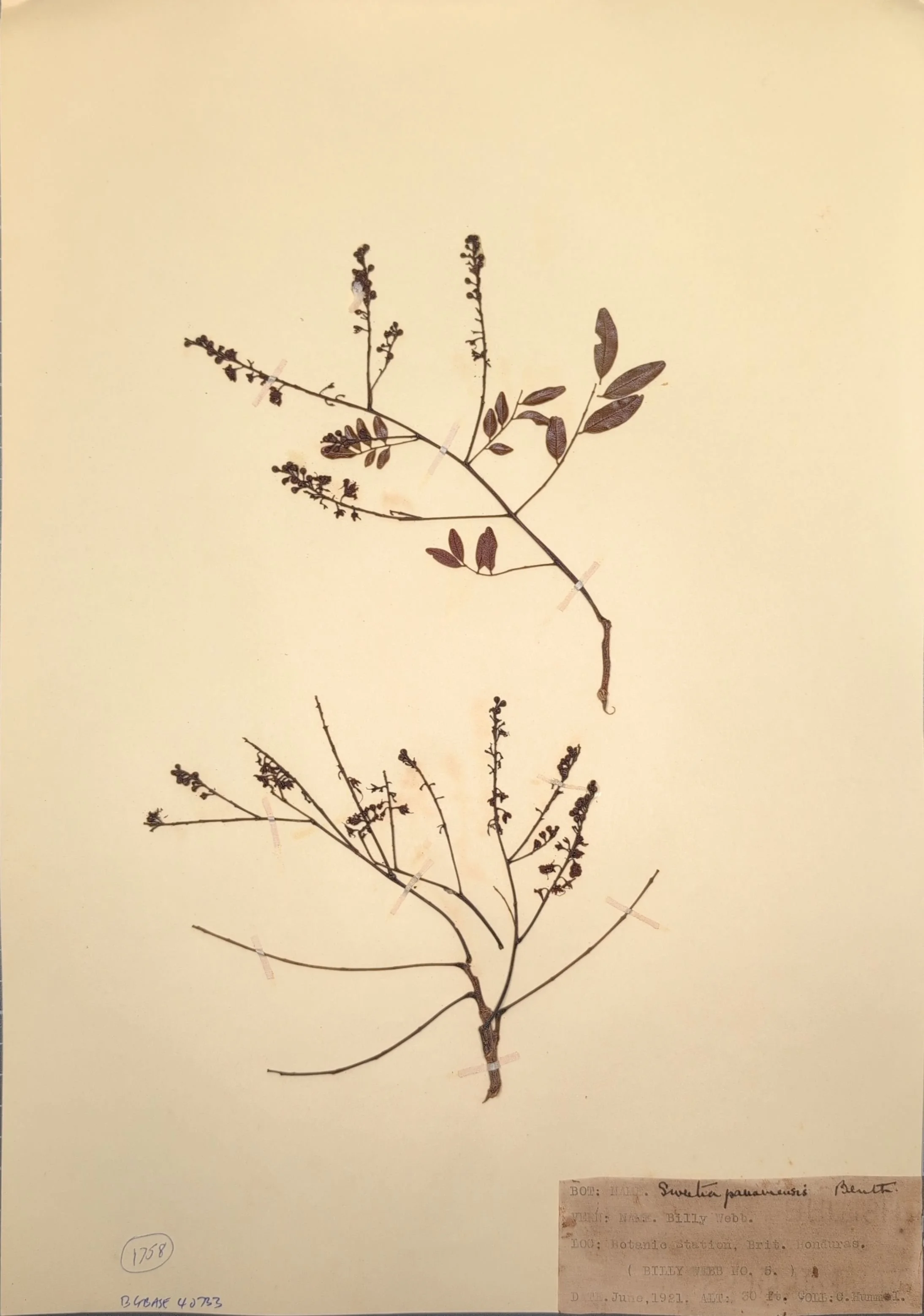
Herbarium specimen of Leptolobium (Sweetia) panamense collected and pressed in June 1921 by Belize’s first CFO, Mr. Cornelius Hummel, housed in BRH, Belmopan, Cayo, Belize; courtesy of BRH
Beyond this earliest collection, an Australian-born botanist named William August Schipp collected plants across Belize with an agenda of both science and commerce.
Schipp collected at least 84 Type Specimens between 1929 and 1935, some of which are held at the National Herbarium of Belize.
Schipp’s Type Specimens include those used to establish a new genus of palms as well as a species of fig named after the collector himself: Schippia spp. and Ficus schippii. There are even Type Specimens that Schipp chose to name after Belize, including: Inga belizensis and Cheiloclinium belizense.
In 1933, Schipp published Flora of British Honduras: Price list of seeds & herbarium material, which, as the name suggests, included pressed specimens from Belize (British Honduras) and offered numerous seeds from Belizean plants for sale, opening up Belizean flora to the broader Western world.
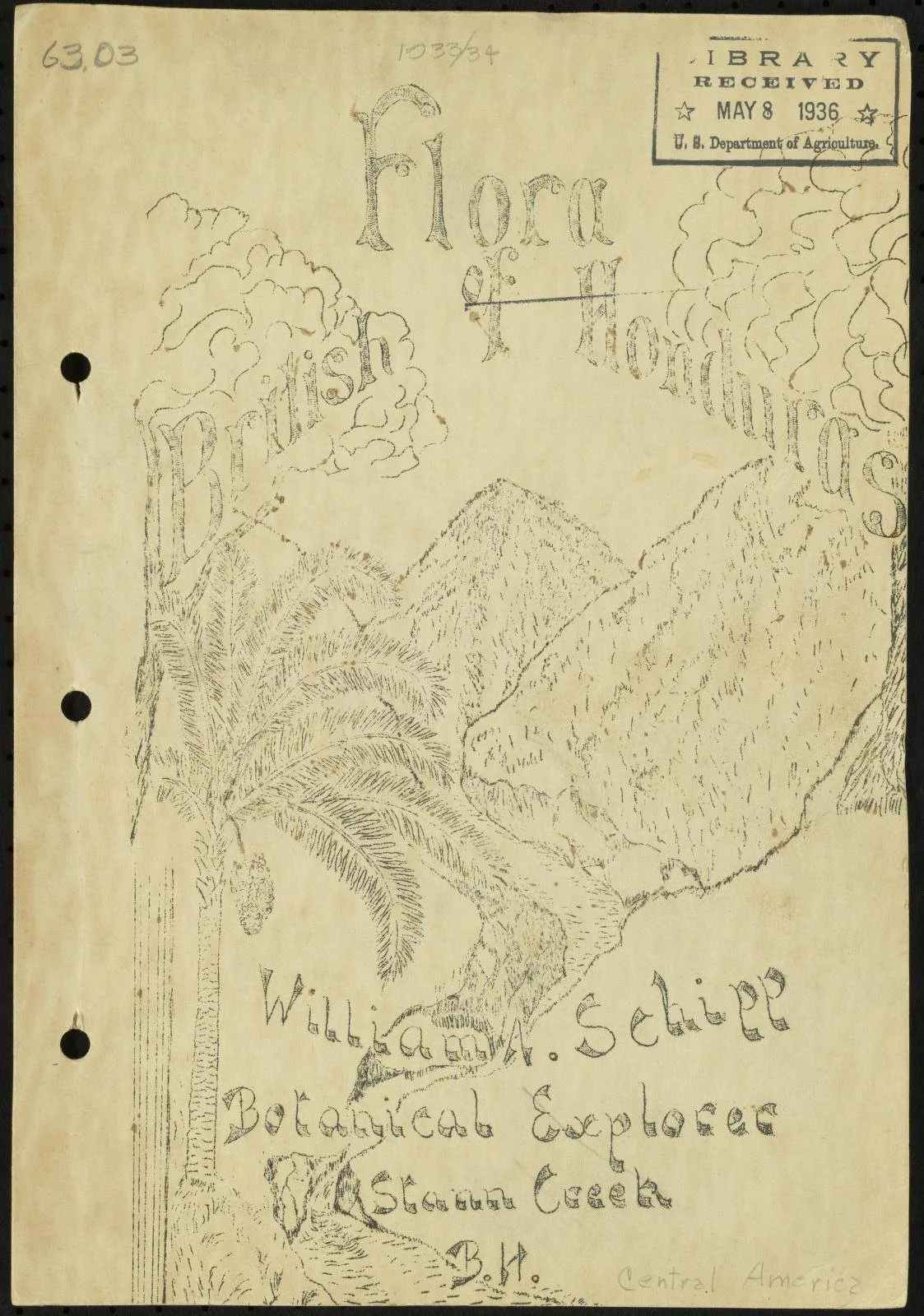
Inside cover illustration of William A. Schipp’s Flora of British Honduras: Price list of seeds & herbarium material; Biodiversity Heritage Library
Many would argue that the pride and joy of the history of Belizean botany is Percy H. Gentle.
Gentle was a Belizean-born botanist who spent the 1930, ‘40s, and ‘50s collecting plants and knowledge of them from all over the country (North Carolina Botanical Garden 2024).
Because he worked with many foreign scientists, many of his specimens are housed abroad in herbaria as prestigious as the Carnegie Museum of Natural History, Harvard Herbaria, Purdue University, Missouri Botanical Garden, and New York Botanical Garden.
Luckily, BRH is also home to some of Gentle’s work, giving Belizeans a great opportunity to study his work from right here at home.
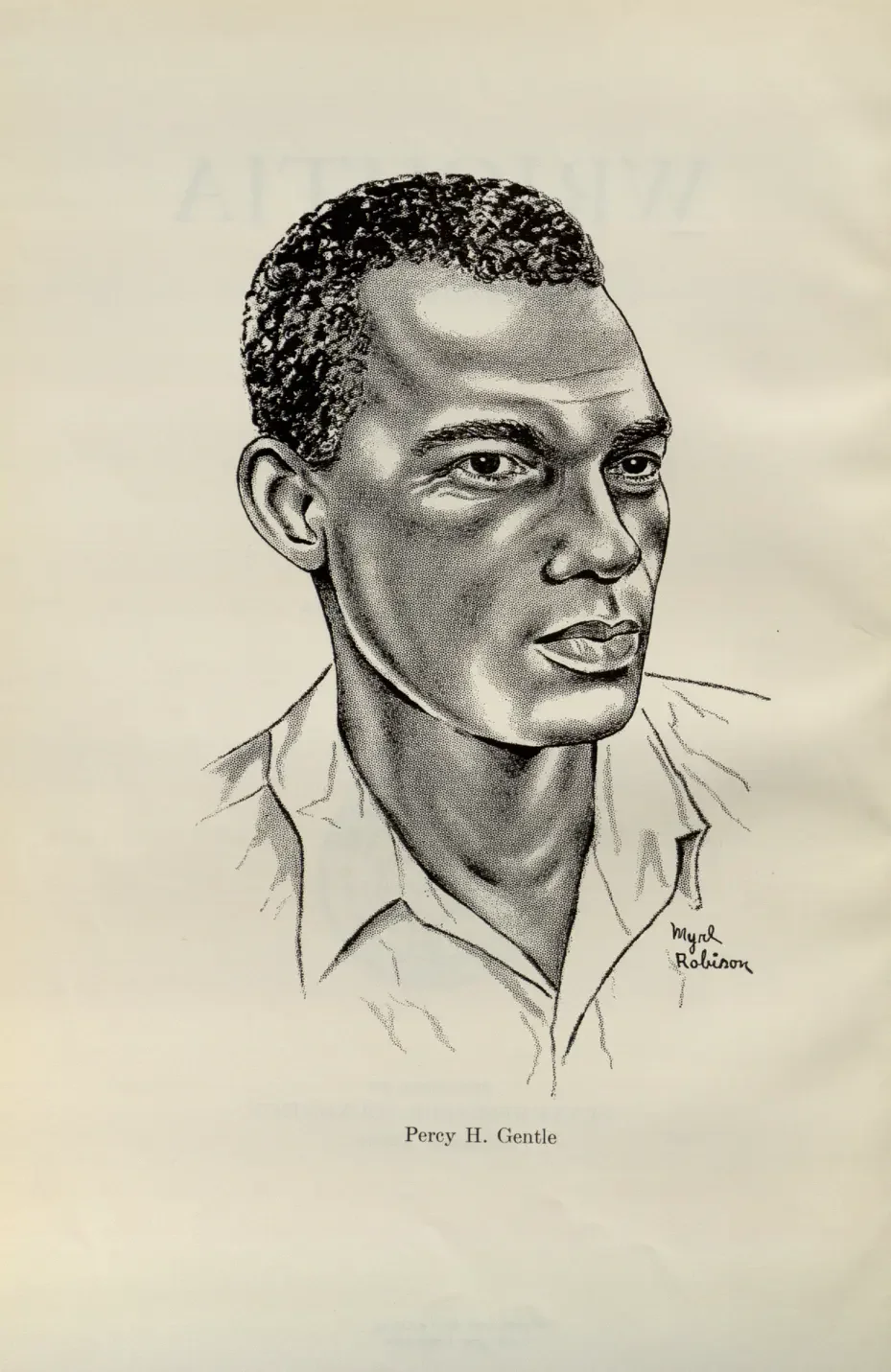
Illustration of Percy H. Gentle by Myrl Robinson from Wrightia volume 3, 1961; Biodiversity Heritage Library
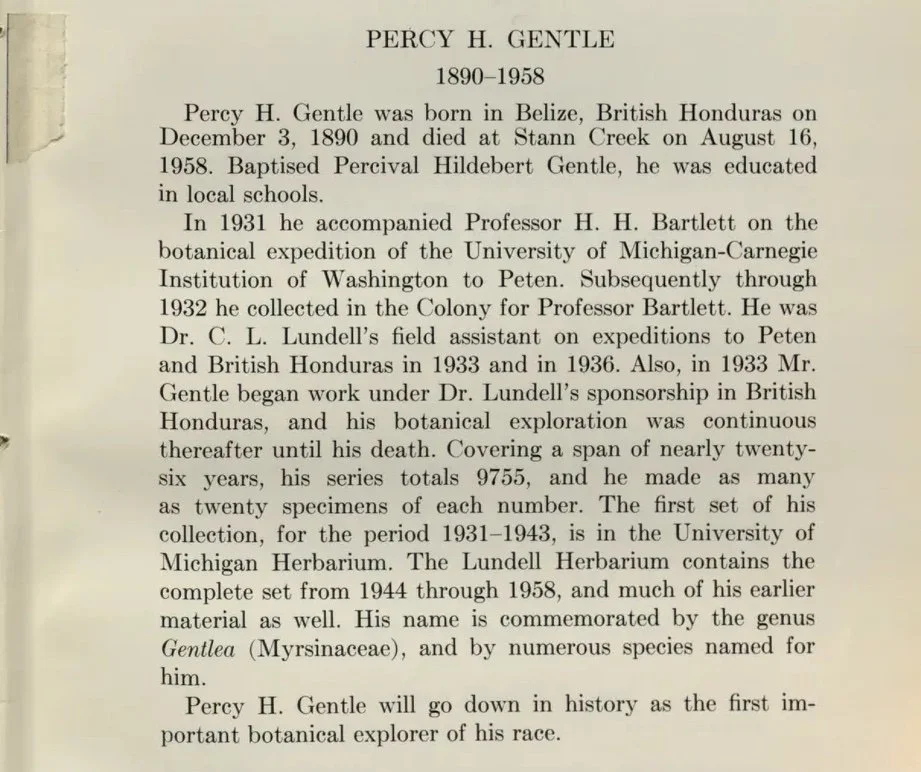
Dedication to Percy H. Gentle from Wrightia volume 3, 1961; Biodiversity Heritage Library
The National Herbarium of Belize holds even more to be discovered, with an estimated 25,000 plant records, there are an infinite number of stories to be told.
Each mounted specimen in the herbarium serves as a record that a plant existed at a particular time and place, in a particular form and condition, and was collected for any number of motivations. These records are increasingly important as our world changes with population expansion, industry growth, habitat loss, and deforestation. They are also invaluable for the history they hold that has shaped our world and our nation.
So, the next time you are biting into a mango or hiking amongst pine trees, know that there is a record of that species neatly mounted on a paper sheet holding a story about Belize’s past and cultural heritage, plant science and conservation, and countless botanists and Belizeans who helped lay the foundation for what we know about and how we live in our world today.
Contact BRH to learn more or volunteer!: belizenationalherbarium@gmail.com
Written by: Drs. Rebecca Friedel Juan and Denver T. Cayetano
REFERENCES:
Antonelli, Alexandre
2020 It’s time to re-examine the history of botanical collections. June 25. https://www.kew.org/read-and-watch/time-to-re-examine-the-history-of-botanical-collections
Ashworth, James
N.d. What is a type specimen? Natural History Museum. https://www.nhm.ac.uk/discover/what-is-a-type-specimen.html
North Carolina Botanical Garden
2024 Percy H. Gentle. Original post February 1, 2022. March 26. https://ncbg.unc.edu/2022/02/01/percy-h-gentle/
Hummel, C.
1925 Report on the forests of British Honduras with suggestions for a far reaching forest policy. Crown Agents for the Colonies, 4, Millbank, London, S.W.1. https://catalog.hathitrust.org/Record/001516622
Park, Daniel
2023 Colonialism has shaped scientific plant collections around the world - here’s why that matters. June 12. https://theconversation.com/colonialism-has-shaped-scientific-plant-collections-around-the-world-heres-why-that-matters-207375
Schipp, William A.
1933 Flora of British Honduras: price list of seeds & herbarium material. Stann Creek, British Honduras. https://archive.org/embed/CAT31395829
Smith, Cathy
2021 From colonial forestry to ‘community-based fire management’: the political ecology of fire in Belize’s coastal savannas, 1920 to present. Journal of Political Ecology, Vol. 28(1):577-606. https://doi.org/10.2458/jpe.2989
Taggart, Emma and My Modern Met Team
2024 What is Botanical Illustration? Learn About the History of This Scientific Art Form. August 18. https://mymodernmet.com/history-of-botanical-illustration
UN-REDD Programme
N.d. Threatened species. https://www.un-redd.org/glossary/threatened-species
Vargas, Ramón and Keith G. Shawe
1997 The Belize Forest Department Herbarium: An analysis of the collections held. Vargas, Ramón and Keith G. Shawe. The Forest and Management Project Occasional Series No. 14, Belmopan, Belize.