Interview with Mr. Stanley Peck - Ximb'al Ich Nukche'
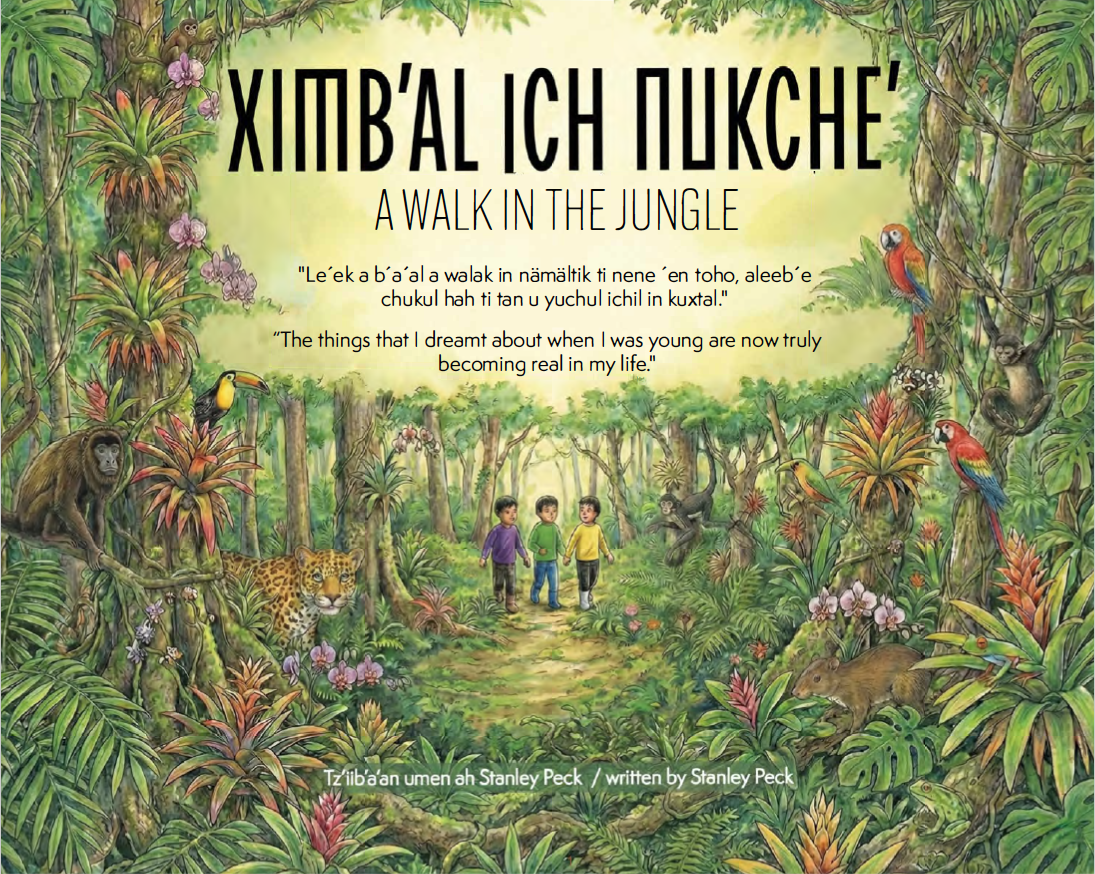
An Interview with Mr. Stanley Peck about Ximb’al Ich Nukche’/A Walk in the Jungle/Una Caminata por la Selva
Q: What is Ximb’al Ich Nukche’/A Walk in the Jungle/Una Caminata por la Selva?
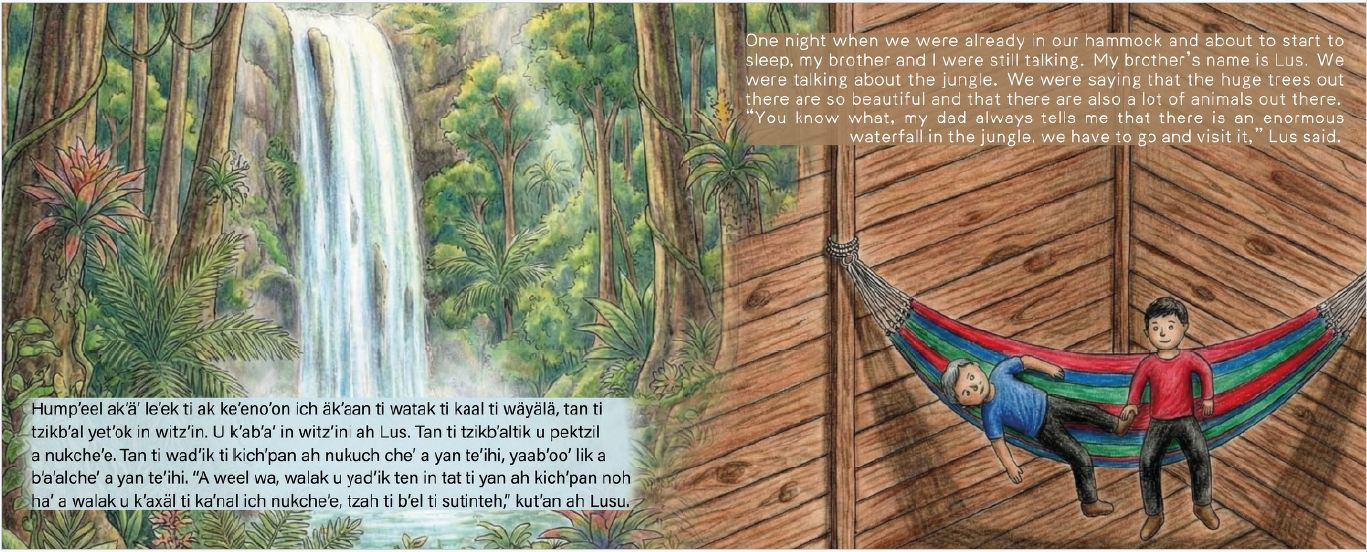
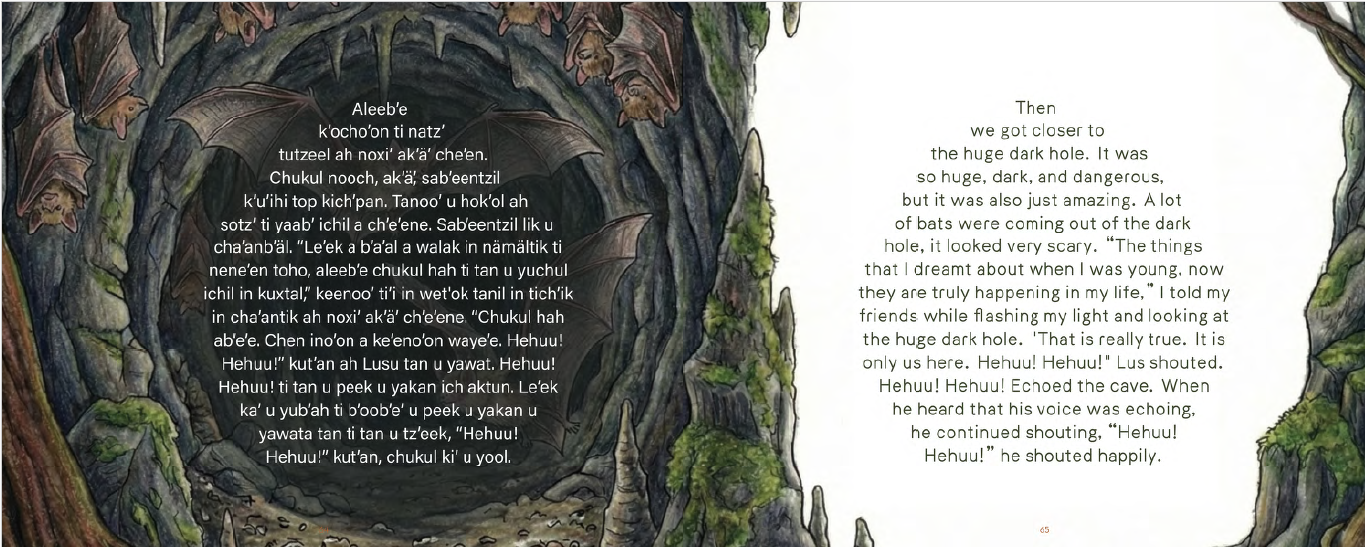
A: All cultural projects that I have been involved in so far are about safeguarding the Mopan language, identity, and heritage. The particular goal of this children’s book is not only the expansion of the Mopan language to the written mode, particularly fictive writing, but also to capture the lived childhood experience of many Mopan children in our villages. The story featured in the book is inspired by my memories as a young boy growing up in the jungle in San Jose Village in Toledo. The story, however, only came alive through the illustrations provided by Richard Karl Peck Jr., a young student and aspiring artist from my village. In addition, Mr. Richard Peck, a primary school teacher from my village, and Dr. Nicole Hober, a linguist from Germany, aided with the proofreading, editing, and other aspects relevant to the writing process. Moreover, José Antonio Flores Farfan, a professor at CIESAS in Mexico and Linguapax’s representative in Latin America, and Camilla Cruz Villa, a graphic designer, are responsible for the graphic design of the book and the Spanish translation of the story.
Q: Can you tell us a little bit about yourself?
A: I was born in 1996 in San Jose Village, a Mopan Mayan community in Toledo. There I grew up and was raised together with my brothers and sisters by Mr. Justino Peck and Ms. Cristina Peck (née Pop). While I also attended primary school in San Jose, I went to high school in Punta Gorda, where I graduated in 2015. After high school, I decided to pursue farming and agriculture, and became also very interested in animal welfare and cattle raising. As a farmer, I combine the traditional ways of farming of our ancestors, while, at the same time, learning from and drawing on modern agricultural practices.
My community, San Jose village, has a population of around a thousand people with some 200 primary school children. The community is located close to the Guatemalan border and approximately an hour's drive away from the district’s capital, Punta Gorda. Although some Mopan people in other parts of Belize might have shifted to using different languages, in my community, virtually everyone speaks Mopan as their first language and uses the language on a daily basis in interaction with other community members. In San Jose, we still follow many of our traditional and customary practices. This is evident, for instance, in the way we farm, prepare food, or build thatch-roofed houses.
Q: What motivated you to create a children’s book in three languages?
A: The book’s story was written entirely in Mopan because it is my native language. I speak it at home and in the community with family and friends every day. It is the language I think in and in which I can best express myself and my emotions. So, when I recall and recount childhood memories, it is in the Mopan language that they surface. The story’s text was, therefore, only later translated into English by me, as English is the official language of Belize and is particularly used in educational and administrative contexts as well as at work and other public places. My English translation was then translated into Spanish by the project collaborators from Mexico. I chose to include a Spanish translation in the book because (a) many Belizeans speak Spanish, (b) it is taught in schools across the country, and (c) Belize is surrounded by Spanish-speaking countries.
Q: Why is children’s literacy important to you and your community?
A: Literacy in Mopan and especially children’s literacy, as the youngest generation and future of our language and culture, is important because it is one way in which the Mopan language can be preserved as part of our heritage. Particularly in today’s day and age, where communication also takes place online on social media, etc., writing or texting become invaluable tools for communicating with other (Mopan) speakers across physical boundaries. We look at computer-mediated communication, for instance, Facebook, we can see that many Mopan people want to write their language and give it a try, but there is a lot of spelling variation, and sometimes it can be difficult to understand what people actually mean, but it is clear that we, as Mopan people, want to read and write in our language.
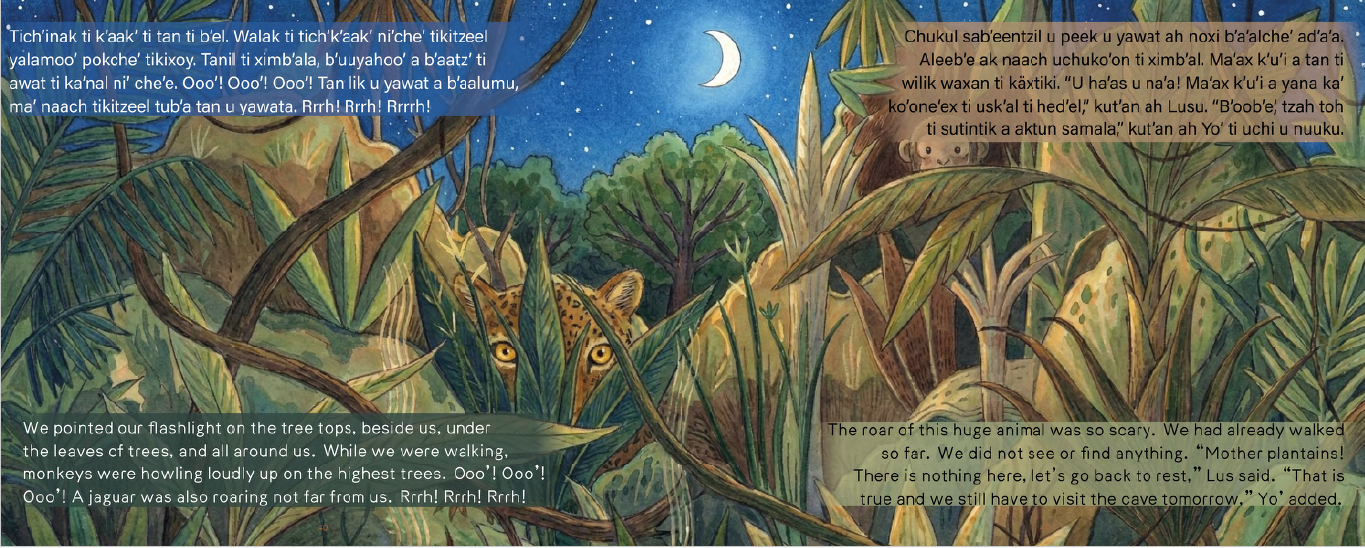
The story of the book captures the practice of walking in the jungle - a practice that is still very much alive in our communities in Toledo. Especially men, from young to old, go on adventures in the jungle. I did that many times with my brother and other friends and family when I was young, and I still do that now. Through walks in the jungle, we not only experience many fantastic, beautiful, and at the same time scary and challenging things, but we also learn more about our environment and how to live sustainably from and with nature and to protect and preserve it for future generations. Aspects of the story will be familiar in one way or another to all Mopan children (and adults) who will read this book. It was very important to me to write a story that Mopan children can relate to, as other texts that we read in school or elsewhere contain stories of other places and other people’s experiences, which are not our own. These are, of course, also interesting to read and learn about, but we also need to have a place of our own for our stories and experiences.
Q: How do you hope people will use your book, and how do you hope it will contribute to the preservation and continuation of the Mopan language?
A: I hope that the book will be used as a resource for advancing Mopan literacy in schools and in other educational institutions that are dedicated to language and culture preservation in Belize. I also hope that Mopan parents might read it as a bedtime story to read to their children, or that children might read it in their pastime as an alternative to, for instance, The Ant and the Dove.
The preservation and continuation of the Mopan language is important to us in our community because we hear and observe that the language is changing. While language change is a natural phenomenon, through these changes, Mopan might be losing some of its features that make it unique and that belong to the essence of the language. To illustrate, when you count things in Mopan, you have to, in addition to the number, use grammatical elements that tell you something about the shape, size, or animacy of what you are counting - in linguistics, they are called numeral classifiers. For example, we use -tuul for humans and animals, which means we say hun-tuul ix ch’up (‘one woman’). Some people have started to say hun-p’eel ix ch’up, although -p’eel is used for things that are not alive, or even hun-kuul ix ch’up, which is generally used for round things. The book tried to represent the traditional usages so that they could be preserved and promoted. I thus hope that this book can be helpful in the context of sustainable language promotion that produces resources that can be used in the future in a way that is fun and understandable to children.
Q: Do you have any other projects you are working on that you can share a bit about with our network?
A: At the moment, I am also, together with Mr. Richard Peck and Mr. Juan Mes, who are both teachers from San Jose Village, carrying out an intergenerational transmission project funded through the Belize Culture Fund, awarded by the National Institute of Culture and History (NICH), called the Mopan Culture Mentors and Apprentices. The goal of the program is to protect and preserve traditional knowledge by bringing together the elders of the community with the younger generations to bridge the intergenerational gap that has emerged in recent decades through structural changes to the way of life in our community. The book that documents the process and outcomes of the project, which focused on embroidery making, traditional basket making, and the telling of traditional folklore, only remains to be printed and shared with the public. The book, too, is bilingual, that is, it is written in Mopan and translated into English.
Q: What can people do to support you and your work?
A: First of all, I would be grateful if people would spread the word about the work that my collaborators and I have been doing over the last couple of years. This not only includes this children’s book and the aforementioned knowledge transmission program, but also the translation of the Little Prince into Mopan, translated by Ms. Elvia Bo and me. The more people learn about our efforts and use the resources we produce, the more we gain visibility with our work, which ultimately all aids towards our greater goal of promoting the Mopan language and culture. I would be happy to talk at school or events about the work I am doing, and if someone reading this blog post would like to invite me for a talk or presentation, they are welcome to reach out to me. Of course, as with many initiatives of this kind, funding for printing books, for instance, always needs to be found. Unfortunately, I was not yet able to find funding for the printing of this children’s book. Any donations, be they large or small, are thus very welcome so I can print the book and distribute it to schools and homes. You can contact me at peckstanley96@gmail.com.